

In this digital world flooded with so much content, we often see businesses second-guessing whether to incorporate a Blog on their Website. To be very honest, we are not surprised. With so much content already out there, does blogging still make a difference? The answer is a definite YES, provided you do it smartly. If you are planning to have a blog just for the sake of others having one, or simply to add more pages to your site, then you are not going to succeed. It takes strategy, consistency, and smart optimization techniques to improve website visibility through blogging. In this post, we will discuss how you can go beyond basic blog writing to actually engage with the right audience, increase visibility, and traffic.
Why Blogging Still Matters for Website Visibility
We all know search engines like Google love fresh content. So, when you publish a blog post, you are providing search engines something new to crawl and index. This is already a big plus, but you can add even more value to it by following smart blogging practices. With smart blogging, you can:
- Target and naturally infuse long-tail keywords in your blog post content.
- Strengthen your website’s internal link structure, and
- Build authority on particular topics that will help your site to become the go-to source in your niche.
7 Key Blogging Techniques to Boost Your Company’s Visibility
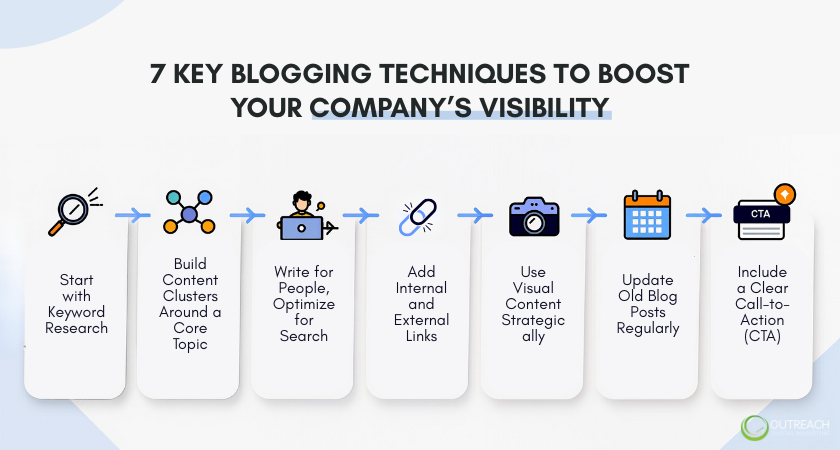
1. Start with Keyword Research
There’s already a ton of content out there, so before you start writing, take a moment to think about who you’re writing for. What is your audience actually searching for? What questions do they need answered? Focus your blog topics around that.
You can use tools like Google Keyword Planner, Ubersuggest, or SEMrush to find out the kinds of search terms people are using. Once you have a list of those keywords, try going after long-tail phrases instead of the super competitive ones, as the latter are much harder to rank. And if you’re targeting a local audience, it is essential to incorporate city- or region-specific terms in your content to achieve better results.
2. Build Content Clusters Around a Core Topic
To gain the trust of your audience and Search Engines, you need to show that you really know your stuff. And one of the best ways to do that is by building content clusters. It is a simple but effective approach. You need to start planning by picking a broad topic that your audience really cares about. Let’s assume that if you are an auto repair business, then “Car Maintenance” could be a good broad topic.
After selecting the broad topic, you need to write a bunch of related blog posts that dig into specific parts of that topic. For example, you could cover topics such as oil changes, tire pressure tips, seasonal checklists, and more. Then link all those posts to your main article, which provides an overview of the core topic. Also, make sure each of the smaller posts links back to that main one. By following this pattern, you can create a strong internal link structure that helps search engines better understand your site. Over time, this will definitely help position you as a go-to source in your niche.
3. Write for People, Optimize for Search
When writing a post, don’t write just for search engines. It’s a common mistake many webmasters make. Your focus should be on your audience, not algorithms. They are the ones reading your content, and if they find it valuable, search engines will follow. Here’s how to keep it balanced:
- Use a clear heading structure throughout your content (H1 for Title, H2 & H3 for Sub-headings).
- Try to answer real questions that your audience might have. You can consider using Google’s “People Also Ask” box to get some great ideas.
- Don’t add keywords forcefully. Include them in your content naturally. If a sentence sounds awkward by adding a keyword, rephrase it.
4. Add Internal and External Links
Adding helpful links (internal or external) to your blog post content is a simple yet effective way to boost your blog’s usefulness and improve SEO. Internal links help readers to explore other important pages on your website and keep them engaged longer. You can also link to relevant, trusted external sources in your blog post, which shows that you have done your homework. Try adding references to reputable studies, industry data, or expert advice to back up your points. This adds credibility to your content.
5. Use Visual Content Strategically
Visuals are nice to have on your blog because they improve engagement, readability, and SEO. These can be images, Infographics, slides, or short videos. You can use these to explain complex ideas simply. Such content enhances your blog’s overall look when added smartly. Make sure to use keyword-friendly file names and descriptive alt tags for every image. Also, don’t overload your post with massive files or too much visual content.
6. Update Old Blog Posts Regularly
Search engines like Google always appreciate fresh/updated content. So, it’s worth checking in on your older blog posts from time to time. A quick update can make them way more useful, help your site stay relevant, and, yes, give your SEO a little boost too. Here’s what you can do:
- Fix stuff that’s out of date
- Add some recent stats or new examples
- Clean up the flow so it’s easier to read
And once you’ve done all that, share it again. Post it on your socials, or drop it in your next newsletter — why waste good content?
7. Include a Clear Call-to-Action (CTA)
Every blog post should lead your readers somewhere. Maybe you want your readers to reach out, grab a free download, or just check out another article. Whatever it is, don’t leave them guessing. Give your readers a little nudge with a clear, simple CTA. Something like:
“Looking to improve your site’s traffic with a proven blog strategy? Let’s discuss.”
Promote Your Blog Content Effectively
Even your best blog post won’t do much if no one reads it. After publishing it, don’t just sit back—get it out there. Here are a few easy ways to spread your content:
- Post it on social media with a good visual and a caption that grabs attention
- Turn it into something new, like a short video, a LinkedIn post, or even an Instagram carousel
- Email it to your list (yes, email still works!)
- Add it to your Google Business Profile updates
- Use tools like Buffer or Hootsuite to schedule your posts ahead of time
Don’t let your blog sit there quietly. Promote it wisely to reach out to maximum number of readers. Promotion is what turns your content into real traffic.

Measure and Improve Your Blog Strategy
After publishing a good number of blog posts on your site, you need to start tracking which ones are performing well. But how do you track that? Tools like Google Analytics and Search Console can help you. With these tools, you can:
- Find out which blog topics and formats perform well
- See which keywords are bringing in traffic
- Monitor time on page and bounce rate
When you find out one of your posts is getting more traction than others, take a closer look at why it’s working. Check out the way it’s written, how it’s laid out, what kind of visuals it uses, and the call-to-action at the end. Then try using that same approach in your coming posts.
Final Thoughts
So, whenever you’re planning a blog post, make sure there’s a purpose behind it. Don’t just write for the sake of it; you should write with a proper plan. That’s how you’ll really start boosting your website’s visibility. Feeling stuck with your content strategy? Don’t stress. Outreach Digital Marketing’s here to help. Let’s chat and see what we can do together!