
Artificial Intelligence (AI) has completely transformed the way we use the internet, and today, its influence is growing across the spectrum, with content creation and search optimization at the forefront, where its impact has been massive. Nowadays, thinking about content creation without AI is unimaginable. However, AI-generated content comes with its own set of risks and rewards, and Google plays a major role in its publication. In this article, we will discuss the risks, rewards, and Google’s stance on AI-generated content to help you out.
3 Risks Associated With AI-Generated Content for SEO
AI-generated content for Search Engine Optimization (SEO) is a complex topic with many pitfalls. Here are the risks of AI-generated content for SEO you need to know about:
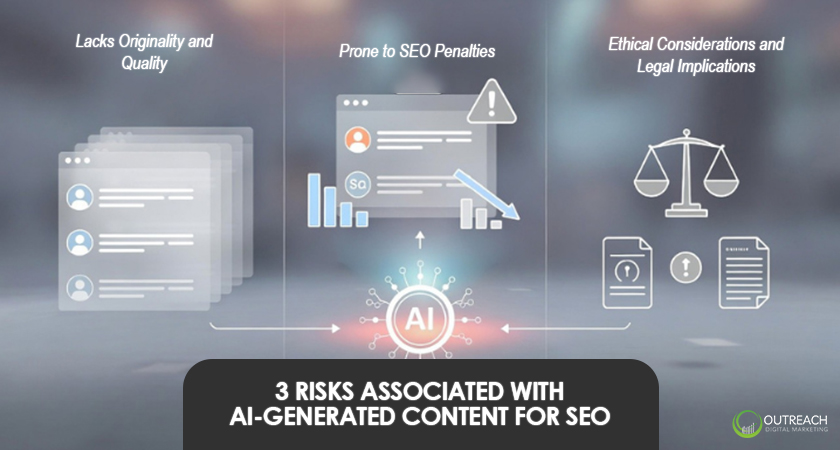
1. Lacks Originality and Quality
One of the biggest concerns raised by many SEO experts about AI-generated content is its lack of originality and quality. Often, AI-generated content lacks the depth and approach of human-generated content. In addition, AI-generated content has earned notoriety for being factually incorrect, attracting negative SEO and eroding user trust. The biggest example of this is deepfake videos, which have been flagged by users worldwide for their propensity to create misunderstandings and disturbances in society. Besides that, the AI models still lack the critical thought process associated with a human brain, which is reflected in human-generated content, with emotional balancing wherever required.
2. Prone to SEO Penalties
The AI-generated content is like a double-edged sword, cutting both ways. To address low-quality, duplicate, and keyword-infused AI content produced specifically to gain rankings, Google rolled out its Helpful Content System (HCS) in August 2022 and continues to update it regularly to filter such content. The primary objective of generating content is to help people, and if AI-generated content lacks credibility, is of inferior quality, or is unhelpful, it will incur negative SEO penalties from Google. Now, if you are widely using such type of content, then you are going to witness a drastic drop in the ranking of your website.
3. Ethical Considerations and Legal Implications
Many users have flagged AI-generated content for being biased against their thoughts and beliefs. This mostly happens because AI models are heavily dependent on vast datasets that also contain the real-world’s inherent biases, lack filtering mechanisms, and generate content that many users flag. The stereotyped content and the discriminatory language present in this type of AI-generated content can land you in legal trouble if any user takes offense to what you have posted. In addition to that, if the AI-generated content closely bears any resemblance to other published content, then it can expose your website to copyright violations.
Rewards of AI-Generated Content for SEO
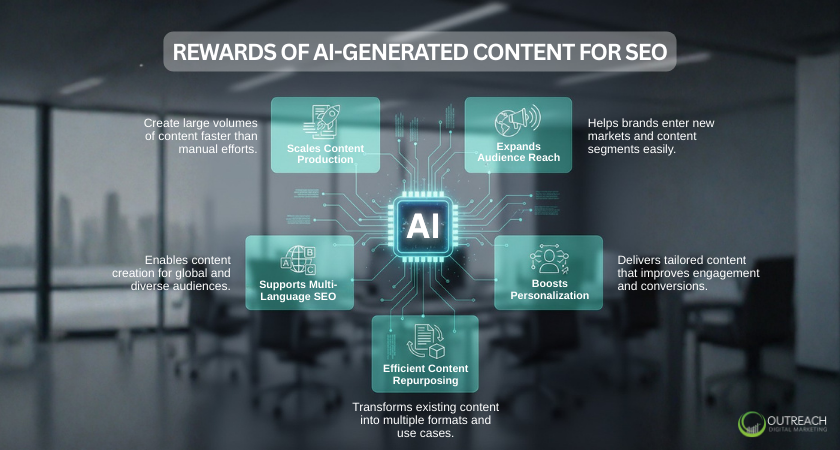
- The scale at which AI can generate content can definitely surpass human capabilities, and this content can be modified to adapt to different user requirements.
- The AI-generated content enables companies to expand their content footprint drastically into segments they were previously incapable of reaching and to reach a wide range of viewers.
- One of the biggest benefits of AI-generated content is that AI models can produce content in multiple languages, giving you access to a global audience that transcends cultural boundaries.
- In addition, AI can be used to produce personalized content that can dramatically boost your engagement and conversions.
- One of the best things about AI is that it can repurpose your existing content, making it adaptable to users’ needs.
Google’s Perspective
Google is very clear about its content policy, focusing on the quality, reliability, and helpfulness of the content, and it doesn’t matter whether it’s produced by AI or humans. In addition to that, if the content produced passes the stringent “spam policy” of Google, designed to catch AI-generated content (that is purely meant for search engine rankings), then Google won’t have any problem with the content. In addition, if the content emphasizes experience, expertise, authoritativeness, and trustworthiness, it aligns with Google’s content policy.
Conclusion
There’s no doubt AI-generated content plays a big role in today’s SEO strategies, and going by Google’s stance on the overall content policy, one thing is clear: you need to satisfy all the criteria of Google to make your AI-generated or human-generated content qualify for the future. Need marketing support when it comes to AI content and optimizing your search engine results? Outreach Digital Marketing is the company for the job. With our expertise and experience, we provide insights to help your company continue to stand out in the ever-changing world of AI.