
Search Engine Optimization (SEO) is a continuously evolving field, with change as the only constant. In fact, in 2025, we’ve seen a drastic shift in the factors that are playing a stellar role in determining the ranking of pages in the search engines. This is evident in the fact that factors that had little to no impact on the 2024 ranking now significantly affect the ranking of pages in 2025. Now, if you want to stay ahead of your competitors in the SEO landscape in 2026, then read on to get to the bottom of these five most important ranking factors of 2025.
1. AI Content Verification and Human Accession
One of the most discussed topics in 2025 was AI-generated content, which had barely scratched the surface in 2024. The discussion centered on whether to impose a penalty on AI-generated content, with widely held views among stakeholders. Moreover, in 2024, Google’s position was defined by producing helpful content, regardless of where it was generated. However, today Google’s stance has changed completely, and the question of whether AI-generated content should be ranked has been replaced by an assessment of AI content.
In simple terms, today, Google focuses on evaluating AI-generated content for originality. While earlier it was only about detecting AI-generated content, the quality, originality, and true value of Such content are now being assessed. In addition, Google is prioritizing genuine, human-generated content that provides tangible insights and is backed by AI. That is, AI-generated content that doesn’t adhere to the E-E-A-T (Experience, Expertise, Authoritativeness, Trustworthiness) principle being used by Google to assess content will struggle with its ranking.
2. User Experience and Task Completion
In 2024, user experience was a priority, with a focus on measuring how long users stayed engaged with a web page. The bounce rate of users determined their experience, and based on this web pages were ranked. The bounce rate may not be a direct factor, but I believe Google is using a variation of it. Nevertheless, today Google’s algorithms have a far more sophisticated understanding of users’ experience and evaluate web pages not only by the time a user spends on a page, but also by whether the purpose for which they visited the page was addressed.
This is, in fact, a call to action, where the empathy displayed for the user is being assessed, and Google is committed to providing its users the best results for their search queries. Now, the websites that are successful in addressing the user intent, provide answers to follow-up questions, and bring the task to its logical conclusion are going to get ranked higher in the Search Engine Results Page (SERP). Moreover, page speed was a major ranking factor in 2025, with Google’s Core Web Vitals, which consider loading performance, visual stability, and interactivity. In 2026, you must monitor and address this on your website.
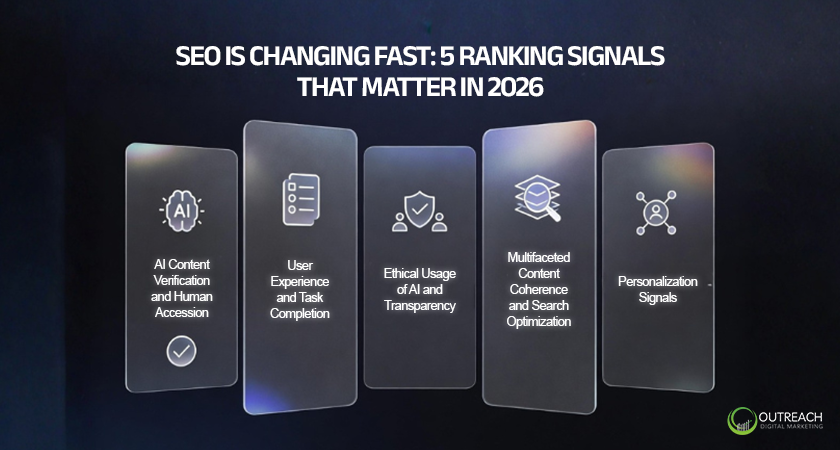
3. Ethical Usage of AI and Transparency
Over the past couple of years, widespread concerns have been raised about the potential for misinformation, bias, and a lack of transparency in AI-generated content. What was previously limited to academic discussions has now entered the realm of SEO in 2025. As Artificial Intelligence has permeated nearly every aspect of our lives, establishing trust and transparency in published content is crucial. Google is always seeking content from creators who use AI responsibly, ethically, and transparently.
The primary focus is on the ethical and transparent use of AI-generated content, given the proliferation of deepfakes and misinformation that makes it difficult to distinguish authentic from duplicate content. That is why trustworthy information sources are becoming more prominent in search engine results, as they validate the direct answers shown in SERPs, whether in AI overviews or knowledge panels. By 2026, you must position yourself as a trusted source in your niche through high-quality content.
This underscores the importance for SEO professionals to ensure clarity (i.e., that the content is human-generated) in content created for ranking purposes. Additionally, if AI is used to generate content, it must be clearly disclosed where required, with a robust fact-checking and verification process to prevent deepfakes and misinformation.
4. Multifaceted Content Coherence and Search Optimization
For the last couple of years, video and image optimization have been integral to the overall SEO strategy, and SEO professionals used to view them separately, with voice search treated as a distant cousin used only for short, direct answers. However, the landscape has changed significantly with the rise of voice, image recognition, and video search, alongside traditional text search.
That is why it is vital to ensure consistency across content formats so they work in unison to deliver effective answers across all search methods. This has become a key trend shaping search engine rankings, and those optimizing content across all formats will see better rankings, as Google focuses on providing users with an interconnected experience that caters to diverse user preferences. You can’t avoid this in 2026!
5. Personalization Signals
Previously, SEO focused on universal rankings, with personalized content playing a very limited role in determining rankings. However, in 2025, Google’s algorithm has improved significantly, able to understand users’ search intent based on their location, device, previous search history, inherent needs, and emotional state, and to provide highly personalized results. In the foreseeable future, generic content will struggle to achieve higher rankings because users today prioritize specificity, and Google recognizes the critical importance of this ranking factor. Content that caters to a niche audience and delves into specific areas will gain traction in rankings over generic content in 2026 and beyond.
In Conclusion
Strictly speaking, these are not direct ranking factors. A wide variety of signals related to these topics are evaluated by search engines to determine the EEAT score, which can be considered a highly important ranking factor. My only intention is to inform our esteemed readers that, although these topics didn’t matter in the past couple of years, it is now difficult to develop a comprehensive SEO strategy without taking them into consideration. In fact, integrating these factors into your strategy will definitely yield you good results in the form of better rankings in search engines in 2026.